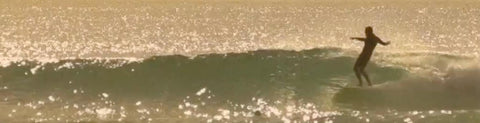
As a young sipper of the holy wine that is Malibu First Point, I was spellbound by one Juan Esteban Bojorquez, aka Steve Krajewski. Dark-skinned, square-jawed, sinewy and elegant, a regular foot, Bojorquez would aim left, pop to feet, crank off the bottom, and place his board in the trim line and just stand there. There was no air guitar flourish. Bojorquez’s brand of casual was earnest, unselfconscious, Duke Kahanamoku-like.

I watched him with great admiration for many years, but never paid much attention to his equipment. Only much later would I learn that Bojorquez rode displacement hulls, a design that melds beautifully with point breaks like Malibu and Rincon. Developed by shaper Greg Liddle in the late 1960s/early 1970s, Liddle explains on his website that they evolved from the George Greenough concept, that they love long and tapering waves, and that they’re not for everyone.
“It is not meant to be a visual experience,” he writes. “It is for the ‘feel.’ To me it is quite beautiful the way they ‘fit’ to the wave and become part of it.”

“It’s a more sensitive thing,” explains Kirk Putnam, who has been riding hulls since the late 1960s, and presently runs the Liddle Surfboards label. “You’re not driving anything with your back foot. The displacement hull is more connected to the water, so it’s more of a delicate feel where you’re riding kind of in the natural curl line of the wave. You’re not trying to destroy the wave or scrub off so much speed. You’re trying to just get in the trim line and feel the wave more. It’s kind of the fly fishing of surfing.”
“I got my first one a little over a decade ago,” says surfer/artist/shaper Tyler Warren. “I like the trim and glide they have, and how you have to think totally different when riding them. They have a suction feel, while also providing lift and speed.”
“They’re a real sexy ride,” says Trace Marshall, of Brothers Marshall fame. “You get ‘em up in the trim line, you step forward, and you’re flying—all gas, no brakes. The beauty of the hull is that the feeling of the ride can never be captured on film. And they look so good on top of a diesel Mercedes.”

According to motorboat terminology, “a displacement hull has a belly, or convex, bottom contour or planing surface. This design does not ride high on the water like a planing hull, instead plowing through and parting the water. A planing hull, on the other hand, will have a flat or concave bottom contour and plane up on top of the water.” Kirk Putnam explains it in surfer’s terms: “With the right sized displacement hull, it’ll just go, and it’ll stay in the pocket. You don’t have to drive it up and down and up and down and keep driving it. It’ll stay in that trim line.”
Malibu ace Jimmy Gamboa is a maestro of the displacement hull. He’s been seen in several surf films slithering magic across Rincon and Malibu on the design, among them One California Day. “They never change,” says Gamboa. “They’re always true to their form. There’s a feel you get from them that you don’t get from any other board. Stay close to the curl, keep it high and tight—that’s where all the speed and trim on a wave is generated from.”

Artist/surfer Alex Kopps got so jazzed on displacement hulls that he started to make a film about them. Then he realized that the essence of the hull is to not make a film about them. “They’re this interesting cartilage between shortboarding and longboarding,” he says. “I love the mystery of them. And I love the reaction people have to them. I was in Australia and I had one, and some people got angry, one guy accused me of having Lynchy (‘60s legend Wayne Lynch) tied up in the kombie.” Kopps laughs. “They’re more about the rider than the surfboard—if you’re interested in problem solving they’re really great. They teach you to think ahead, ‘cause you’re going so fast, in a straight line. And they’re a conduit to surf history.”
On a recent day at First Point a friend was riding a displacement hull. I paddled up to him and asked how he liked it. “Fun as shit,” he said, and unsaddled, and shoved it towards me. There was something incredibly Big Wednesday-esque about this gesture. It was like we were playacting surfers. A wave came. It was waist-high and friendly. I caught it, and abruptly caught a rail. This happened on the next wave, and the one after that. Finally, I got a good one, and finessed a bottom turn, and put the board in that glorious trim line, where the wave does all the work, and we the lucky rider get to just hang out and enjoy the glide. And it was exactly that, a smooth, forward-mowing, giddy glide. I was amazed by the speed. As Putnam put it, “it’s kind of a fourth gear.” I was probably way too careful and mesmerized to look anything like the regal Juan Esteban Bojorquez, but for a few seconds I could feel like him, and that was the point.

For more displacement hull go to liddlesurfboards.com